Home · Texas · Possumhaw Holly
Shrub · Deer-resistant
Possumhaw Holly
Ilex decidua
Also called: Deciduous Holly
Updated 2026-09-23
Drops its leaves in fall to reveal branches packed with scarlet berries that glow through winter and feed cedar waxwings and robins in late season.
Possumhaw holly spends spring and summer as an unremarkable green shrub, easy to overlook next to showier natives. Then it drops its leaves for winter and the reason to grow it becomes obvious: bare branches packed with red to orange berries that stay put for months, exactly when the rest of the garden has nothing going on.
Getting those berries depends on one detail nurseries don't always explain clearly, which is worth understanding before you buy.
Growing & care
Female plants fruit; site a male nearby or rely on wild pollinators. Takes wet clay and occasional flooding — good for low spots. Limb up for a striking winter silhouette.
Where possumhaw holly grows in Texas
It's native from Maryland to Florida and west into Texas and Mexico, and in Texas it's especially common in river bottoms, coastal plains and wet woods, as well as fence rows across the eastern half of the state. It tolerates clay, loam and sandy soil, and it's one of the few substantial shrubs that genuinely doesn't mind a spot that holds water after rain.
How to plant possumhaw holly
Plant container-grown stock in fall or winter. Almost everything sold at a nursery is grown from softwood cuttings taken in June or July, which root in six to eight weeks, rather than from seed, because seed-grown plants take a long time and won't reliably look like the parent. That matters because cutting-grown stock is propagated specifically from berry-producing female plants, which is the detail that determines whether your shrub ever fruits.
Watering possumhaw holly the first year
Water regularly through the first year or two while it settles in. It tolerates both routine garden watering and occasional flooding without complaint, which makes the establishment period fairly forgiving compared to most natives.
Possumhaw Holly care through the seasons
Left alone, it tends to send up multiple stems from the base and form a dense thicket. If you want a single-trunk small tree instead of a multi-stemmed shrub, prune out the competing stems while the plant is young; it's much harder to correct the shape once several trunks are established.
Common possumhaw holly problems
The most common complaint isn't a pest or disease, it's a shrub that never berries. That almost always means it's a male plant, which flowers but doesn't fruit, or a female with no pollinator nearby. Buying a cutting-grown, nursery-identified female largely solves this, since wild pollinators will usually find it even without a male planted close by.
Wildlife value of possumhaw holly
The white spring flowers, blooming March through May, are a pollinator source, and the winter berries feed cedar waxwings, robins and other birds specifically in late season, when many other food sources have already been picked over.
Using possumhaw holly in the garden
Use it as a large accent shrub or small tree, typically reaching 15 to 30 feet with a rounded to vase-shaped form, in a spot that gets some winter sun so the bare, berry-covered branches actually show. It's also a genuinely useful choice for a low area that collects rainwater, where many shrubs would eventually struggle.
Possumhaw Holly FAQ
How do I make sure my possumhaw holly berries every year?
Buy a cutting-grown plant sold as a named female selection rather than an unlabeled seedling. A male plant flowers normally but never sets fruit, and there's no way to tell the two apart until bloom time without that label.
Do I need a male and female possumhaw holly to get berries?
Not necessarily. Wild pollinators can carry pollen from a male plant elsewhere in the neighborhood, so a single female often fruits well even with no male planted nearby.
Can possumhaw holly handle a spot that floods occasionally?
Yes, it's one of its strengths. It tolerates wet clay and occasional standing water better than most shrubs of its size, which makes it a good fit for a low spot in the yard.
Bloom season
In bloom: Mar–Apr · Colors: white
Where to buy
Look for possumhaw holly (Ilex decidua) at: native Texas nurseries.
Guides featuring possumhaw holly
- The Best Native Plants for Clay Soil in Texas
- Native Alternatives to Common Non-Native Plants in Texas
Sources
Range, nomenclature, and the USDA symbol above come from the federal plant record for this species. Check it yourself:
Good for
Plant it with
Natives that pair with possumhaw holly
Same conditions, same uses — species that share possumhaw holly's growing requirements and belong in the same bed.
Wax Myrtle
Morella cerifera
A fast, dense, aromatic evergreen that makes an ideal privacy screen and fixes its own nitrogen.
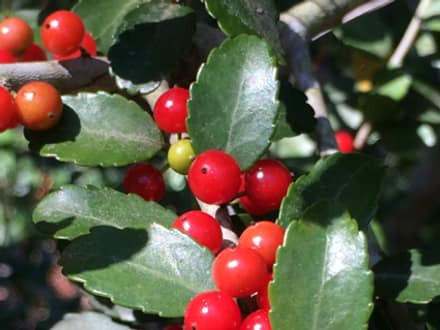
Yaupon Holly
Ilex vomitoria
An adaptable evergreen holly that takes sun or deep shade, wet or dry, and covers itself in translucent red berries that hold all winter for the birds.
Inland Sea Oats
Chasmanthium latifolium
The rare ornamental grass that thrives in shade, dangling flat, papery seed heads that shift from green to bronze and rustle all winter.
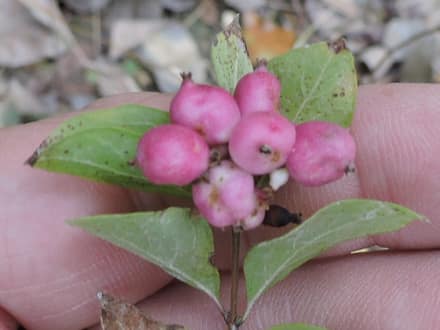
Coralberry
Symphoricarpos orbiculatus
A modest suckering shrub for shade that comes into its own in fall, when the arching branches string themselves with clusters of coral-pink berries the birds strip by spring..
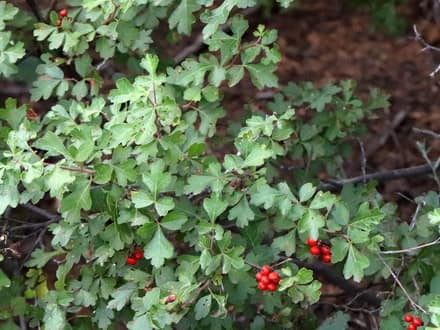
Fragrant Sumac
Rhus aromatica
A low, spreading shrub that blazes orange-red in fall and holds slopes with its suckering roots.
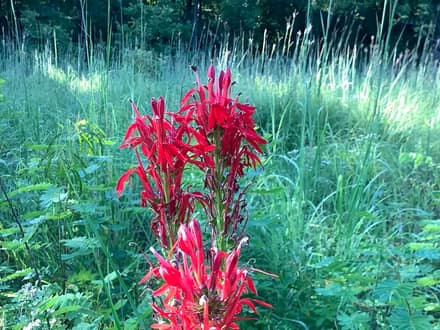
Cardinal Flower
Lobelia cardinalis
Spikes of the most intense scarlet of any native flower, rising from moist shade in late summer.