Home · Texas · Four-nerve Daisy
Perennial · Deer-resistant
Four-nerve Daisy
Tetraneuris scaposa
Also called: Hymenoxys, Bitterweed
Updated 2026-09-23
A tidy evergreen tuft that lofts cheerful yellow daisies on wiry stems in nearly every month of the year. Tough as nails and endlessly cheerful.
Four-nerve daisy is one of the few Texas natives that treats blooming as a year-round job rather than a season. In a mild winter it can carry a few yellow flowers even in January, and it rarely goes fully without bloom from February through November, all from a plant that asks for rocky, lean soil and almost nothing else.
Growing & care
Wants rocky, sharply drained soil and full sun. Shear off spent stems to keep it neat. One of the longest-blooming natives for edging and rock gardens.
Where four-nerve daisy grows in Texas
The Native Plant Society of Texas lists it across the Central Great Plains, Chihuahuan Deserts, Cross Timbers, Edwards Plateau, High Plains and Southern Texas Plains, covering most of the western two-thirds of the state. It's built for dry plains, rocky hillsides, open grasslands and rocky outcrops, and it wants clay, dry, limestone, rocky or sandy soil that drains fast.
How to plant four-nerve daisy
Direct sow fresh seed outdoors in fall, pressing it lightly into the soil surface rather than burying it, since it needs light to germinate. It can also be started from cuttings taken in spring or early summer. Container plants go into the ground any time from fall through spring, in full sun to light part shade.
Watering four-nerve daisy the first year
Water occasionally through the first season to help roots establish, then back off. This is a plant where restraint matters more than attention: consistent overwatering is a more common way to lose it than underwatering.
Four-nerve Daisy care through the seasons
Shear off spent flower stems periodically to keep it neat and encourage more bloom, otherwise it needs almost no upkeep. Avoid watering it too often, since frequent water makes it grow leggy and open rather than staying in its naturally tidy, tufted form.
Common four-nerve daisy problems
Too much water or too rich a soil is the main way it struggles, usually showing up as a loose, sprawling plant instead of the compact tuft it forms in lean, well-drained ground. It has few pest or disease problems otherwise.
Wildlife value of four-nerve daisy
It's a steady nectar source for bees and butterflies across its long bloom season, valuable in particular for how much of the year it keeps producing flowers when many other nectar sources have finished.
Using four-nerve daisy in the garden
Use it for edging, rock gardens, or container and hanging-basket plantings, all settings where its low, tidy form and near-constant bloom read well up close. It also works scattered through a xeric bed as reliable color between the peak bloom windows of larger perennials.
Four-nerve Daisy FAQ
How long does four-nerve daisy bloom?
Nearly year-round in a mild Texas winter, with flowers appearing from February through November and sometimes even into January. It's one of the longest-blooming natives on the site.
Why is my four-nerve daisy leggy instead of compact?
Usually too much water. It naturally forms a tight, tidy tuft in lean, well-drained soil, and frequent watering makes it grow open and sprawling instead.
Does four-nerve daisy work in a container?
Yes, its small size and tolerance for lean, fast-draining soil make it a good fit for containers and hanging baskets, not just in-ground beds.
Bloom season
In bloom: Nearly year-round · Colors: yellow
Where to buy
Look for four-nerve daisy (Tetraneuris scaposa) at: native Texas nurseries.
Sources
Range, nomenclature, and the USDA symbol above come from the federal plant record for this species. Check it yourself:
Good for
Plant it with
Natives that pair with four-nerve daisy
Same conditions, same uses — species that share four-nerve daisy's growing requirements and belong in the same bed.
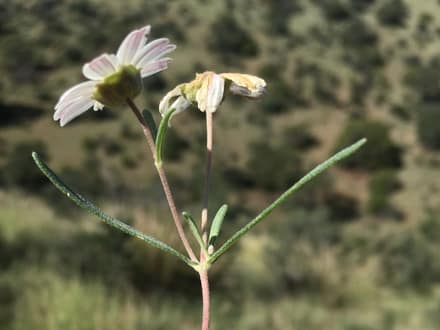
Blackfoot Daisy
Melampodium leucanthum
A tidy mound smothered in honey-scented white daisies for most of the year.
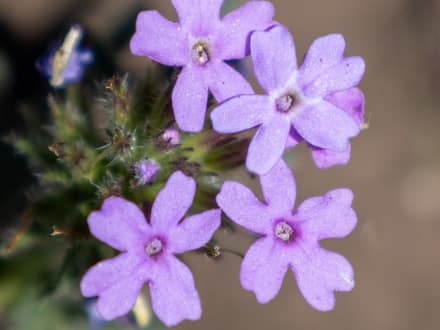
Prairie Verbena
Glandularia bipinnatifida
A low, spreading mat of purple flower clusters that bloom nearly nonstop and draw butterflies constantly.
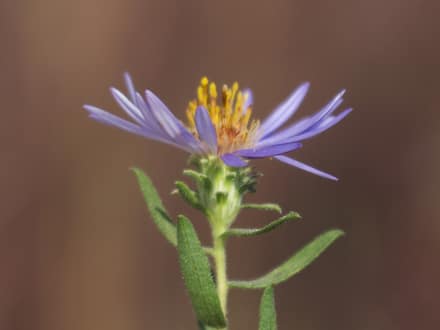
Fall Aster
Symphyotrichum oblongifolium
A mounding aster that vanishes into the background all summer, then bursts into a haze of blue-purple daisies in October — a lifeline of late nectar for pollinators..
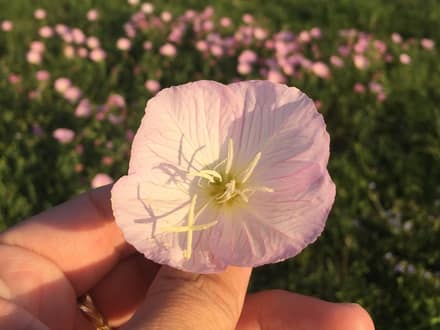
Pink Evening Primrose
Oenothera speciosa
The pink cups that wash over Texas fields and roadsides in spring.
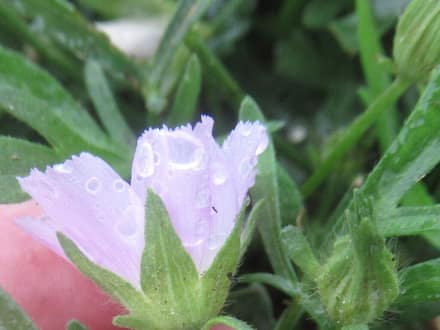
Winecup
Callirhoe involucrata
A sprawling perennial that spills chalice-shaped magenta flowers across the ground each spring.
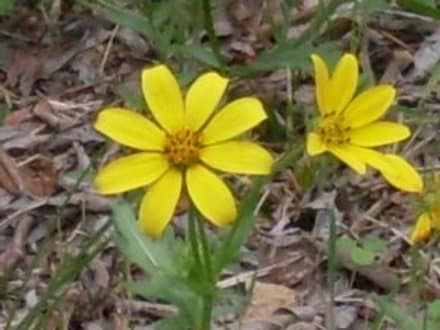
Engelmann Daisy
Engelmannia peristenia
A deep-taprooted prairie daisy that blooms yellow for months and shrugs off drought better than almost anything — its flowers even fold in the midday heat to conserve water..